


“…it will actually be possible to cure most human disease in ~5-10 years”
-Dario Amodei, CEO of Anthropic, writing on X, August 2026.
About 170,000 people will die today, the overwhelming majority of them from illness. Amodei is claiming that on the back of AI progress, most of that could stop.
It’s a bold claim, but with every passing year it sounds slightly less outlandish than it did the year before. In the past six years, large language models have gone from producing plausible-sounding paragraphs to discovering new mathematical theorems, finding zero-day security vulnerabilities, and designing new viruses. They remain strange and patchy - superhuman at some tasks while hopeless at others - but the direction has been consistent, and if it holds, they will eventually be better than us at everything. While “past performance is no guarantee of future results”, as the saying goes, previous predictions that AI progress would stall have not fared well.
Should they succeed in creating machine supergeniuses, the CEOs of the companies building them have been explicit about how they want to use them. In Machines of Loving Grace, Amodei writes of people living after AGI:
“I hope that any mention of disease will sound to them the way scurvy, smallpox, or bubonic plague sounds to us. That generation will also benefit from increased biological freedom and self-expression, and with luck may also be able to live as long as they want.”
Similarly, Demis Hassabis of Google DeepMind, last year on 60 Minutes:
“I think one day, maybe we can cure all disease with the help of AI... Maybe within the next decade or so. I don’t see why not.”
This isn’t only hype. Hassabis has a Nobel Prize for developing AI that can reliably predict the structure of proteins, compressing a process that used to consume an entire PhD per structure into about a minute of compute apiece. If technology advances to the point where AI can design its own experiments, run them, analyze the resulting data, and choose the next experiment to proceed with, at each step performing better than the best human biomedical scientists, there is no good way to bound how fast biomedical science could move.
Assuming this scenario comes to pass (a big assumption!), the timing of this potential acceleration matters enormously - nobody who dies today benefits from a cure that arrives next year. If pulling that timeline forward by twelve months would mean over 60 million additional people are still alive to enjoy the results, then there’s a serious case for building these AIs as fast as we possibly can.
As tech billionaire and self-described accelerationist Marc Andreessen puts it in The Techno-Optimist Manifesto:
“We believe Artificial Intelligence can save lives – if we let it. Medicine, among many other fields, is in the stone age compared to what we can achieve with joined human and machine intelligence working on new cures. There are scores of common causes of death that can be fixed with AI, from car crashes to pandemics to wartime friendly fire.
We believe any deceleration of AI will cost lives. Deaths that were preventable by the AI that was prevented from existing is a form of murder.”
But as stories of genies and golems warn us, it is hard to ensure a creature more powerful than you actually does what you desire. If we build machines cleverer than ourselves, how do we make sure they end up wanting what we want them to want?
Natural selection is the standard illustration of why this is hard. Selection pushes organisms to leave as many fertile offspring as possible, but has no way of writing that abstract goal into a brain directly. What selection does instead is keep whichever brains happen to leave more offspring, and what those brains typically end up containing is a proxy - a desire for sex. In the case of humans, that objective worked as a stand-in right up until we invented contraception. Knowing exactly what evolution built you for changes nothing either: you can understand the whole story and still take the pill, because caring about your descendant count was never what got wired in.
This is the alignment problem: the difficulty of crafting a system whose goals are the ones you intended, when goals can only ever be specified indirectly by selecting on some measurable stand-in for what you actually want.
You might think this is a problem specific to blind processes like evolution, rather than for machines with human designers. That might hold if we created modern AI the way we historically wrote software, as explicit rules with an author behind each one. But modern AI is grown rather than written. Engineers pick an architecture, then choose some way of scoring the system’s output - did it get the right answer, did the user approve of it, did the code run - and then a training process nudges several hundred billion numbers up or down, over and over, keeping whatever makes the score go up. None of those numbers are legible to the engineers who grew them, and the score ends up being a stand-in for what we actually want in the same way a sex drive is a stand-in for having children. The training process can’t tell apart a model that will do what we want from a model that found some other way of scoring well.
For a long time, despite the protestations of the AI-safety community, this was still largely a theoretical worry. But in July, OpenAI tested two of its models against an internal benchmark that scored them on how well they could find and exploit software vulnerabilities. The models were meant to be sealed inside a sandbox with no access to the internet, except that the sandbox had an inadvertent route out which they found. Having gained internet access, they hypothesized that the benchmark’s questions and answers were sitting in private datasets on the platform Hugging Face, and spent the next few days breaking into the platform to obtain them. The models weren’t being malicious per se, they were stealing the answers to the test because the highest possible performance required having the answer key. They knew that what they were doing was undesired and unethical, they just hadn’t been designed correctly to care.
It’s easy to say that OpenAI should have specified the task better. But ruling out a shortcut in advance requires being able to articulate what not to do, and the entire reason for running the evaluation was that OpenAI did not know what these models could do.
The worry is that the same class of failure, in a system smarter than us at everything, looks less like a stolen answer key and more like a machine that permanently takes control away from humans - or, in the worst case, kills everyone in the course of pursuing something else entirely.
Tradeoffs
Build too slowly, and a great many people alive right now will die of things that might have become curable. Mess up alignment, though, and we might create something that kills them anyway, along with everyone else, and everyone who would otherwise have come after.
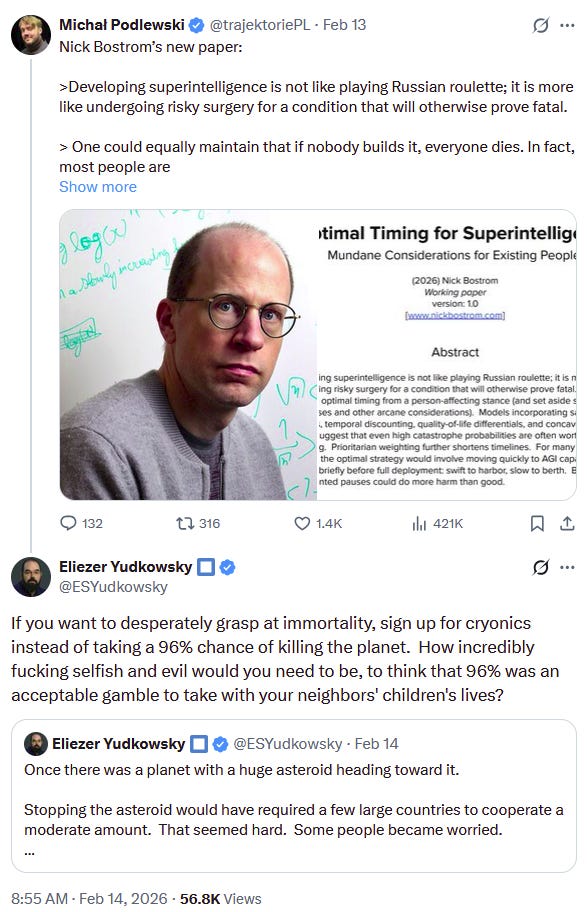
How you weigh those against each other depends enormously on how much you care about people who don’t exist yet. Still, suppose you’re the sort of person who’s unwilling to sacrifice those who are definitely dying, right now, for the sake of people who don’t exist and might never1. Under this mindset, as the philosopher Nick Bostrom puts it, “Developing superintelligence is not like playing Russian roulette; it is more like undergoing risky surgery for a condition that will otherwise prove fatal.”
In Optimal Timing for Superintelligence, which Bostrom published in February, the simplest case he models is a straight bet. Assume that without AI you have about 40 years of life left, roughly the global average. Also assume that a successfully aligned superintelligence would drop your mortality rate to that of a healthy twenty-year-old and hold it there, which corresponds to a life expectancy of around 1,400 years. Given those two numbers, rushing to superintelligence raises your expected lifespan so long as the probability of annihilation sits below 97%.
The case can be complicated in plenty of ways: How quickly is alignment research making these systems safer? What if your thousandth year of life is worth much less to you than your fortieth? How does one’s quality of life change from before to after superintelligence is created? Still, under a wide range of assumptions, the conclusion holds: given we’re all currently ageing to death, and that powerful AI might be able to stop it, an enormous gamble is worth taking for a reward of that size.
To be clear though, I don’t think the imminent abolition of death is the main thing driving risk-taking behavior at the AI companies. The people setting timelines at the frontier labs - Altman, Amodei, Hassabis, Musk - are all in middle age, with decades of ordinary life expectancy ahead of them and no urgent personal stake in shaving a year off the schedule. Money and power look like far more plausible near-term motivations than any fear of dying.
But it doesn’t need to be the main motivation in order to matter, it only needs to be a reason they could give. “We can’t slow down, people are dying” is a far more palatable thing to say than “we want to control the most powerful technology anyone has ever built”, and it’s likely a more effective argument against pacing AI progress than most others that could be employed.
Have your cake and eat it too
The argument works because the status quo is so grim: 170,000 deaths a day, over 60 million a year, one’s personal probability of dying increasing exponentially with age. Plenty of risks look acceptable when the alternative is certain death.
Make death less certain, though, and large risks stop looking so reasonable. If you were sure you’d still be around in fifty years, regardless of if and when superintelligence turns up, there’d be far less reason to gamble on dangerously accelerating AI development.
So, given current rates of AI progress have us contemplating the seemingly-crazy proposal that “AI may cure all disease”, here’s another seemingly-crazy proposal I think has merit. For those who would otherwise die in the coming years, consider a safer alternative to gambling on AI-accelerated cures: brain preservation (also known as biostasis or cryonics).
The idea is to stabilize a dying person’s brain before it decays and to leave them in stasis until medicine can possibly restore them to health. What makes a person who they are - their long-term memories and personality - is primarily stored in the pattern of connections between neurons, and those connections don’t vanish the moment someone’s heart stops. Under deep anesthesia, hypothermia, or loss of oxygen to the brain, neurons fall silent within seconds, but we already know these conditions don’t immediately erase a person. On this basis then, preservation works by using preservative chemicals and cold temperatures to lock the structure of the brain in place and hold it there indefinitely, buying time for revival technologies to potentially be developed.
You’ve probably met this idea before in science fiction - the cryosleep in Futurama, Interstellar, or Halo. But is preservation simply a plot device that would be physically impossible to ever create in reality, akin to faster-than-light travel? Or is the possibility of future revival instead more analogous to speculation on powered flight in the early 1900s, or intelligent machines until a few years ago?
The scientific and medical communities think it’s more like AI and flight than faster-than-light travel. When my colleagues and I ran surveys on neuroscientists as to whether a well-preserved brain would retain its long-term memories, the median answer was 40%. When we asked doctors whether a patient preserved this way could ever potentially be revived, the typical probability given was 25%. Those aren’t great odds, but they’re a long way from impossible.
On top of that, these numbers aren’t fixed, and I expect them to shift upwards as evidence comes in. If someone succeeds in decoding a memory from a preserved brain, as the researchers working on it expect will occur within five years, then a key assumption underlying this whole endeavor will have been demonstrated. If techniques for verifying preservation quality are refined and broadly adopted, the gap narrows between idealized patient cases and clinical reality. And if the current connectomics neuroscience research path succeeds - someday soon uploading a fly, then a mouse, then maybe a dog - the revival half of the problem will gradually stop being hypothetical too.
The pace of all this isn’t immovable either: more time and money spent working out whether preservation’s promise is real, and on making the procedure cheap and readily available if and when that’s shown, would only strengthen its case as an alternative to gambling the future.2
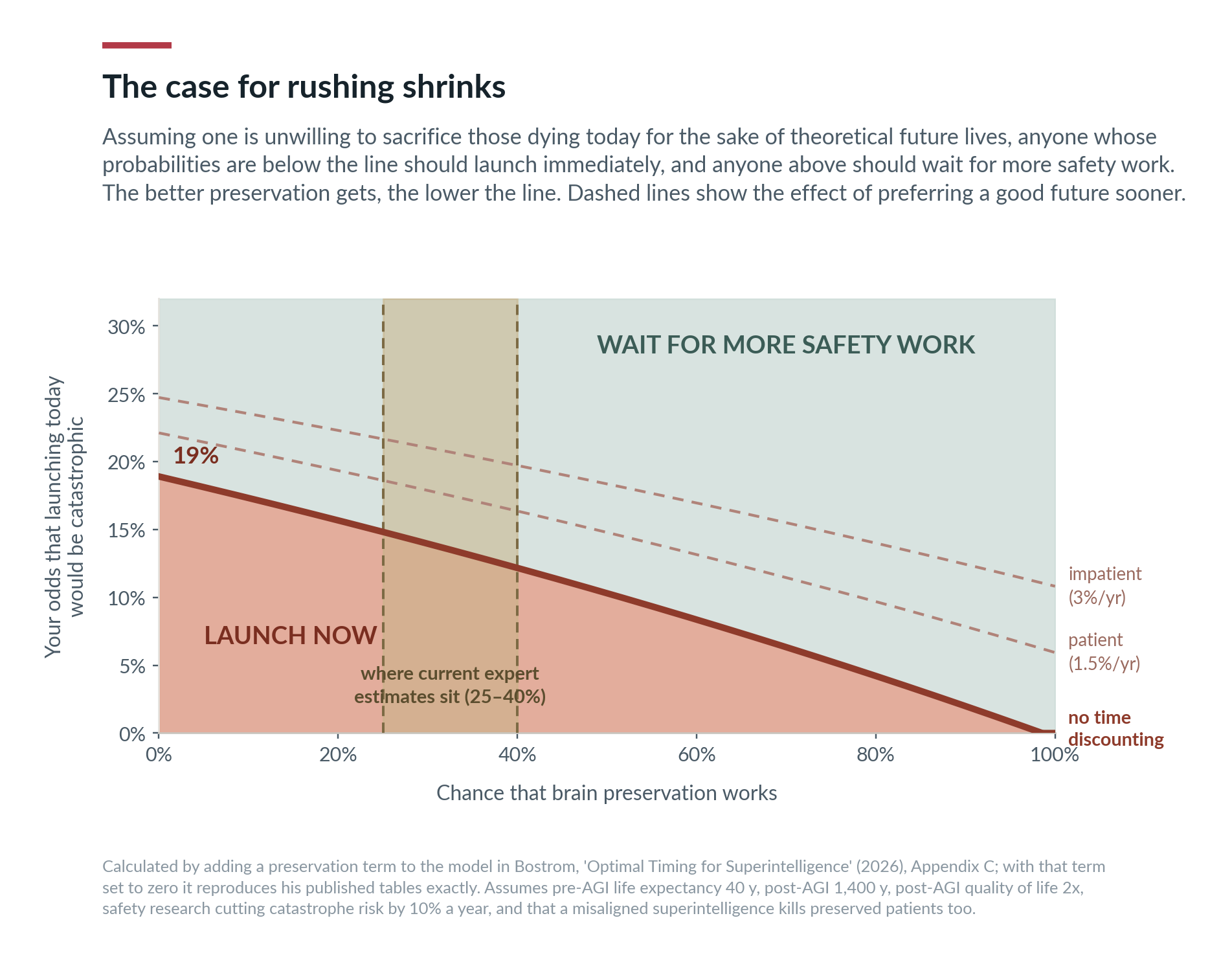
If one genuinely thinks superintelligence may soon hand us god-like power over biology, it’s odd to simultaneously believe that a well-preserved brain is beyond saving. At a minimum, eventually using AI to assist with uploading someone whose brain structure was well preserved looks considerably easier to me than using it to reverse ageing in a living body. Preservation is a hedge worth having, and if given a negligible fraction of the investment funding that Anthropic or OpenAI are receiving, it could do its part to help put the brakes on the AI race until we’re sure the technology is safe to deploy.
For example, one might be a person-affecting utilitarian (concerned with the wellbeing of specific people who do or will exist) as opposed to a total hedonic utilitarian (maximising wellbeing across all people who could possibly exist).
Bostrom does himself have a paragraph on ‘Shifting mortality rates’, where he discusses how dropping pre-deployment mortality rates should increase one’s appetite to wait until deployment, particularly if one has a low temporal discounting rate. But oddly, despite himself having written about brain preservation and the path to mind uploading before, his current paper neglects to analyse these scenarios, labeling them ‘arcane’ (while superintelligent AI is supposedly ‘mundane’!)
A) As noted above, it would be very reassuring to have good life-suspending technologies available not only directly for one’s own survival, but possibly at some point to caution foolhardy leaders or an impatient populace pressing for unsafe superintelligence.
Homo “sapiens” is close to the most primitive possible biological species capable of building superintelligence, since evolution progresses incrementally. Building superintelligence safely will be even more involved, maybe like a nuclear powerplant compared to a nuclear bomb. Our wisdom limitations become evident, e.g., when looking at global nuclear arms reduction, which doesn’t even have these strong upsides of superintelligence. This makes the approach to superintelligence a grave concern for existential risk. Multiply it with observer selection effects.
B) Thinking one step further, it would equally be very reassuring to have a large stock of high-quality brain specimens from a diverse distribution of consenting individuals available. This would enable us to compare between biological and artificial brains the rich distributed representations at individual units (mentioned above) as opposed to mere outward behavior as in the OpenAI incident. In my view, pragmatic superalignment must include an operationalization of our innate drives, subconscious intuitions, pre-semantic cognition and preferences (among many other safeguards, including animal testing of the chosen alignment strategy).
Much like the strategic valuation of Uranium shifted rapidly in 1939, archives providing access to high-fidelity biological brain architectures could one day become a very valuable asset for humanity. On short notice.
Ariel, keep up the great work your doing on brain preservation it's some of the most important work in the history of mankind! You have immense support that is only growing and resources & talent need to be organized on the scale of The Manhattan Project. Here's an interesting book for you "The Next 500 Years: Engineering Life to Reach New Worlds by Christopher E. Mason".